
What Is a Personal Loan Prepayment Penalty and How to Avoid It

personal loan prepayment penalty

Getting a personal loan can be an effective way to handle large expenses or pursue debt consolidation. Before you finalize the loan agreement, you must understand all the conditions involved. One of the most important clauses to look for is a personal loan prepayment penalty.

A personal loan prepayment penalty is a fee some lenders charge if you decide to pay off your loan early. This can feel unfair, as paying off debt ahead of schedule seems like a positive financial step. However, lenders have specific reasons for including this clause in their contracts.

This guide explains everything about a personal loan prepayment penalty. We will cover what they are, why lenders implement them, and how you can avoid them. We will also discuss your options if you currently have a loan with this type of fee.

Table Of Contents:

What Is a Personal Loan Prepayment Penalty?

A prepayment penalty is a fee that some lenders charge when you pay off your personal loan before the agreed-upon loan term ends. This penalty fee is designed to compensate the lender for the interest they lose out on.

Not all personal loans include prepayment penalties. Many modern lenders now market their loans as having no such fees to attract more borrowers.

Still, it is always wise to review the fine print of any loan agreement before signing.

Types of Prepayment Penalties

Prepayment penalties are not all the same. They can be structured in a few different ways, which will affect how much you might have to pay. Understanding these structures can help you better assess a loan offer.

For example, it could be a flat percentage of your remaining loan balance. If you have a $10,000 loan balance and a 2% prepayment penalty, you would owe an extra $200 to pay it off.

Another structure is a sliding scale penalty, where the fee decreases the longer you hold the loan. For example, the penalty might be 3% in the first year, 2% in the second, and so on.

Some lenders may charge a fixed number of months of interest. If you pay off the loan early, you might still owe the next three or six months of interest payments. It is crucial to identify which type of penalty your loan has to calculate the potential cost accurately.

Why Do Lenders Charge Prepayment Penalties?

Lenders are in the business of making money, primarily through the interest they collect over the life of a loan. When you secure a personal loan, the lender calculates their expected profit based on you making every monthly payment for the full repayment term. If you pay off the loan early, their anticipated profit is reduced.

Prepayment penalties are a tool for lenders to protect their projected revenue. This fee helps them recover some of the interest income they lose from an early payoff. It also discourages borrowers from frequently refinancing their loans whenever interest rates drop, which provides lenders with a more stable and predictable income.

From the lender’s point of view, it is a risk management strategy, particularly with loans that bad credit applicants secure. For borrowers, however, it can feel like a punishment for being financially responsible. This fee can be a frustrating and costly surprise if you were not aware of it.

How Common Are Prepayment Penalties on Personal Loans?

Fortunately for borrowers, prepayment penalties on personal loans are becoming less common. The financial market is competitive, and many lenders have removed these fees to appeal to consumers. Customers today demand more flexibility and transparency in their financial products.

While many mainstream lenders have done away with them, prepayment penalties have not disappeared entirely. You may still find them in loan agreements from certain lenders, especially in the subprime market or for loans offered to individuals with a low credit score. Some specialized business loans or consolidation loans might also include them.

It is important to remain vigilant when shopping for a personal loan. Always assume a prepayment penalty could be part of the deal until you have confirmed otherwise. Reading your loan documents carefully is the only way to be certain about your lender’s policy on paying a loan early.

How to Avoid Personal Loan Prepayment Penalties

The simplest way to avoid a prepayment fee is to select a lender that does not include one in its loan terms. Here are some strategies to help you find a loan that allows for an early payoff without extra charges.

1. Read the Fine Print

Always review the loan agreement meticulously before you sign. Look for any language that mentions a prepayment penalty, prepayment fee, or early payoff fee. The Truth in Lending Act (TILA) disclosure statement should clearly state whether a penalty for paying the loan early exists.

2. Compare Multiple Lenders

Do not settle for the first loan offer you receive. Compare quotes from several lenders, including online lenders, local credit unions, and traditional banks. When comparing, look beyond the interest rate and origination fee to see their policy on prepayment.

Many online lenders and credit unions prominently advertise personal loans with no prepayment penalties as a key benefit. Creating a simple comparison can help you visualize the total cost and flexibility of each option. This due diligence can save you a significant amount of money and frustration.

Here is a table to illustrate typical lender characteristics:

Lender Type Typical Prepayment Penalty Policy Other Considerations
Online Lenders Often have no prepayment penalties. Fast application process, competitive rates for good credit.
Credit Unions Very likely to offer loans without prepayment penalties. Member-focused, may offer lower rates and more flexible terms.
Traditional Banks Varies; some may include them, especially on larger loans. May offer benefits for existing customers with a checking account.
Subprime Lenders More likely to include prepayment penalties. Serve borrowers with bad credit but often have higher rates and fees.

3. Negotiate with the Lender

If you have a preferred lender but their standard loan agreement includes a prepayment penalty, try to negotiate. Lenders may be willing to remove the clause to win your business. This is especially true if you have a high FICO Score and a strong credit history.

4. Consider Shorter Loan Terms

Lenders are less likely to attach prepayment penalties to loans with a shorter loan term. If you believe you can afford a higher monthly payment, opting for a shorter term might help you avoid the penalty. This approach also saves you money on total interest paid over the life of the loan.

What to Do If Your Loan Has a Prepayment Penalty

If you discover that your existing personal loan has a prepayment penalty, you still have options. The right choice will depend on your financial situation and the specific terms of your loan.

1. Calculate the Cost

Your first step is to determine the exact cost of the prepayment penalty. Compare that amount to the total interest you would save by paying off the loan now. If the interest savings are greater than the penalty, it may still be financially beneficial to pay the loan off early.

2. Wait It Out

Some prepayment penalties are only active for a specific period, such as the first two years of the loan. This is sometimes referred to as a “call protection period.” If you are near the end of this window, it might be best to wait until the penalty period expires before making your final payment.

3. Make Partial Prepayments

Your loan agreement might permit you to make partial prepayments without triggering the full penalty. For instance, some loans allow you to pay up to 20% of the original loan balance each year without a fee. Making extra payments within these limits can help you reduce your principal and pay off the debt faster without incurring a penalty.

4. Refinance

A loan refinance can be a strategic move if current interest rates are lower than your loan’s rate. You would take out a new loan, ideally with no prepayment penalty, to pay off the old one. Just ensure that the savings from the new, lower interest rate are substantial enough to cover the prepayment penalty on your original loan.

This strategy is common for many types of debt, from a student loan to an auto loan. Refinancing can also be part of a larger debt consolidation plan. A debt consolidation loan combines multiple debts into one, simplifying your finances with a single monthly payment.

The Impact of Prepayment Penalties on Your Finances

Personal loan prepayment penalties can affect your overall personal finance strategy more than you might think. The presence of a penalty introduces a financial barrier to becoming debt-free sooner.

1. Higher Total Cost of Borrowing

The most direct impact is the increased cost of your loan. A penalty fee adds to the total amount you pay, potentially negating the interest you would save by clearing the debt early. This can make a seemingly affordable loan more expensive in the long run.

2. Reduced Financial Flexibility

These penalties limit your freedom to make financial decisions. If you receive a bonus at work or a financial windfall, a prepayment penalty might make you hesitate to use that money to pay down your loan balance. This lack of flexibility can hinder your progress toward financial goals, like building your savings account or making other investments.

It’s important to have financial flexibility to manage life events, which requires considering products like life insurance or having an emergency fund. A restrictive loan can make managing your broader financial life more difficult.

3. Slower Debt Payoff

Knowing a penalty awaits can discourage you from making extra payments. This can result in you staying in debt for the full loan term, even if you have the means to pay it off sooner. This prolonged debt can affect your credit utilization ratio and your ability to secure new credit or build credit effectively.

Keeping a loan open longer might have a minor positive impact on the age of your credit accounts on your credit report. However, the benefits of eliminating debt and freeing up cash flow usually outweigh this small factor.

Alternatives to Personal Loans with Prepayment Penalties

If you are looking for financing but are committed to avoiding a prepayment penalty, there are several alternatives to consider. Exploring these options can help you find the flexibility you need.

1. Credit Union Loans

Credit unions are member-owned, not-for-profit institutions, so they often offer more consumer-friendly terms than traditional banks. They frequently provide personal loans with competitive interest rates and no prepayment penalties. You will need to become a member to apply, but membership criteria are often broad.

2. Online Lenders

The online lending space is highly competitive, which benefits borrowers. Many online platforms specialize in personal loans and clearly state they do not charge prepayment penalties. They often offer a quick and easy application process, making them a convenient choice.

3. Home Equity Loans or HELOCs

If you are a homeowner, you may be able to borrow against the equity in your home. Home equity loans and home equity lines of credit (HELOCs) often have lower interest rates than unsecured personal loans. However, these loans use your home as collateral, which is a significant risk to consider.

4. 0% APR Credit Cards

For smaller borrowing needs, a credit card with a 0% introductory Annual Percentage Rate (APR) can be an excellent penalty-free option. You can make a large purchase or use a balance transfer to move existing credit card debt. The key is to pay off the entire balance before the introductory period ends, as the interest rate will increase significantly afterward.

Conclusion

Understanding the details of a personal loan prepayment penalty is a critical part of being an informed borrower. While these fees are less frequent than they used to be, they can still present a costly obstacle to your financial goals. Being aware of this potential fee can save you from an unwelcome surprise.

Always review the loan agreement, compare offers from different lenders, and do not hesitate to negotiate terms if you want to pay a personal loan early. By doing your homework, you can find a personal loan that offers the funds you need with the flexibility to pay it off on your own schedule.

Not all loans are the same — interest rates and terms can vary a lot. LendWyse gives you a clear side-by-side view, so you know exactly which option is the best fit for you.

How to Pay Off Debt on Your Credit Report

Staring at a credit report filled with debt can feel like being stuck in a maze. You see the entries, the numbers, and the negative marks, but the exit sign is blurry. You are asking yourself how to pay off debt on a credit report because you want to find that exit and start fresh.

It is a stressful situation that feels like a heavy weight on your shoulders. This guide will show you how to pay off debt on your credit report and begin cleaning things up, one step at a time.

It is not a race; it is about making steady progress toward financial freedom.

Table Of Contents:

First, Understand Your Credit Report

Before you can fix the problem, you need to know exactly what you are up against. Think of your credit report as a financial report card, detailing your history of borrowing and repaying money. Lenders use this report and the associated credit scores to decide if they will loan you money and at what interest rate.

Three major credit bureaus create these reports: Experian, Equifax, and TransUnion. Each bureau receives information from your lenders, including credit card issuers and auto loan providers. This means your report could be slightly different at each one, which is why you must check all three for a complete picture of your personal finance situation.

You are entitled to a free credit report from each bureau every week. Use a government-authorized site like AnnualCreditReport.com to get them safely. Be wary of other sites that promise free reports but may have hidden fees or try to sell you services you do not need.

When you get your reports, look through each account listed. You will see details on your student loan balances, personal loan payments, and more. Make sure you recognize every account and that the information is correct.

It is also a good idea to understand the scoring models that turn this report into a number, like the FICO® Score. Different credit scoring models weigh factors differently, but payment history and amounts owed are always significant. Checking your reports can also help you spot consumer alerts placed on your file.

Finding the Debts That Hurt Your Score Most

Not all debt is created equal on your credit report. Some items can drag your credit score down much faster than others. Your main job is to spot these high-impact negative items so you can focus your efforts where they will make the biggest difference.

Look for collection accounts, which indicate the original creditor sold your debt to a debt collection agency. A collection account is a major red flag to new lenders, whether it stems from an old credit card or unpaid medical debt.

You also need to find any charge-offs. A charge-off is similar to a collection, meaning the original creditor has written your debt off as a loss for their accounting. However, this does not mean you are off the hook; you still owe the money, and it badly hurts your score.

Late payments are another credit score killer. The report will show if you were 30, 60, or 90 days late on a monthly payment. The later the payment, the more it hurts, and even one late payment can stay on your report for seven years.

How to Pay Off Debt on Credit Report: Crafting a Plan

Now you have your reports and have highlighted the problem areas. It is time to make a plan of attack. Feeling a little overwhelmed is normal at this stage, but having a solid plan makes everything feel more manageable and gives you a clear path forward.

Prioritize Your Debts

You likely cannot pay everything at once, so you need to decide where to start. Two popular money management methods can help with this decision. One focuses on building momentum, and the other focuses on saving the most money.

The debt snowball method involves paying off your smallest debt balance first while making minimum payments on everything else. Once the smallest debt is gone, you roll that payment amount into the next smallest debt. This creates a “snowball” effect and gives you quick wins, which can be great for motivation.

The debt avalanche method targets the debt with the highest interest rate first. Mathematically, this approach saves you the most money over time on interest charges. However, it might take longer to see the first debt disappear completely.

Debt Snowball vs. Debt Avalanche
Method Focus Pros Cons
Debt Snowball Smallest Balance First Provides quick psychological wins and builds motivation. Simpler to follow. May cost more in total interest over time.
Debt Avalanche Highest Interest Rate First Saves the most money on interest. Mathematically most efficient. May take longer to pay off the first account, which can be discouraging.

Dealing with Collection Agencies

Talking to a debt collection agency can be intimidating, but remember, you have rights. The Fair Debt Collection Practices Act (FDCPA) protects you from harassment and unwanted calls at unreasonable hours. Collectors must operate within legal boundaries.

Your first step should be to ask for a debt validation letter, and you must do this in writing. This letter forces the agency to prove that you owe the debt and that they have the legal right to collect it. Never admit you owe the debt over the phone before you get this proof.

Always communicate with debt collectors in writing, sending letters via certified mail with a return receipt. This creates a paper trail that can protect you. Keep copies of everything you send and receive as evidence in case of a dispute.

The Power of Debt Settlement

Many people do not realize that you might not have to pay the full amount on old debts. This is especially true for debts in collections, which an agency bought for a fraction of the original value. This allows them to make a profit even if you pay less than what you owe. This process is called debt settlement.

You can call the collection agency and offer a lump-sum payment to settle the debt. If you owe $2,000, you might offer $800. They may negotiate, but do not send any money until you have a signed agreement in writing stating that your payment will satisfy the debt in full.

Debt settlement can be a powerful tool for paying a large debt, saving you money and letting you move on. Some people hire a professional debt settlement company to handle these negotiations for them. This can be helpful if you are uncomfortable negotiating or have multiple accounts to settle.

Pay for Delete: A Possible Game Changer

Paying off a collection account is good, but getting it removed from your credit report entirely is even better. This is what a “pay for delete” agreement accomplishes. You agree to pay the debt, often a settled amount, and the collection agency agrees to delete the negative account from your credit reports.

Not all collection agencies will agree to this, as it is technically against the reporting agencies’ policies. However, many smaller agencies are willing to do it. It is always worth asking for because a paid collection still looks negative to lenders, while a deleted one is gone for good.

Just as with a standard settlement, get this agreement in writing before you pay a dime. This written confirmation is your only proof that the agency promised to remove the item. Without it, you have no recourse if they fail to follow through.

Exploring Other Debt Repayment Avenues

Besides directly tackling individual debts, other strategies can consolidate your payments and potentially lower your interest rates. These methods can simplify your financial life and make you debt-free faster.

One popular option is debt consolidation. This involves taking out a new loan to pay off multiple existing debts. You could use a personal loan from a bank or credit union for this purpose, which can be a good choice if you have a decent credit score.

A debt consolidation loan combines your debts into a single monthly payment, often with a lower interest rate than what you were paying on credit cards.

Another option is a balance transfer card, which offers a 0% introductory APR for a period. This allows you to pay down the principal balance without accruing interest, but watch out for transfer fees and the interest rate after the promo period ends.

If your credit is not strong enough for a loan, you might consider a debt management plan (DMP) through a nonprofit credit counseling agency. A credit counselor will work with your creditors to lower your interest rates and create a structured management plan. You make one monthly payment to the agency, and they distribute it to your creditors according to the plan.

What Happens After You Pay?

Paying off a debt is a huge milestone, so give yourself some credit. Your work, however, is not quite done. You need to follow up to make sure your credit report reflects your hard work, which is a critical part of improving your credit history.

After you have paid a debt or settled an account, wait 30 to 60 days. Then, pull your credit reports again from all three bureaus. Check that the account is listed as “paid in full” with a zero balance or, if you had a pay-for-delete agreement, that the account is gone completely.

What if it is not updated correctly?

Mistakes are common. If you find an error, you have the right to dispute it. The Federal Trade Commission provides clear steps on how to file a dispute with the credit bureaus online or by mail.

Keep monitoring your credit regularly as part of your credit protection strategy. This is not a one-and-done fix. Building good credit is a long-term habit, and watching your report helps you catch future errors and signs of fraud.

You might even use a service that offers a free dark web scan to see if your personal information has been compromised.

When You Need Professional Help

Let’s be honest: this whole process can feel like a full-time job. Between figuring out who to pay, negotiating settlements, and filing disputes, it can get very complicated. It is easy to feel stuck or like you are not making progress, a normal feeling when facing a large amount of debt.

You do not have to do this all on your own. Sometimes, bringing in an expert can make all the difference, especially when dealing with complex collection debt or multiple creditors. They understand the laws, know how to talk to creditors, and can handle the paperwork for you.

A reputable credit counseling agency can help you create a budget and may offer a debt management plan.

On the other hand, if you have some money in a savings account or are making money from a side hustle for a lump sum, a debt settlement company may be a good option. Getting professional help is a smart move to fix your finances faster and more effectively.

Conclusion

Learning how to pay off debt on a credit report is about taking back control of your financial life. It begins with understanding your report and identifying the accounts doing the most damage to your credit scores.

From there, you can create a strategy, whether it is the snowball or avalanche method, debt consolidation, or negotiating settlements with collection agencies.

The path forward may have its challenges, but it is clear and very possible to achieve. Remember to follow up after each payment to make sure your report is accurate and reflects your hard work.

Debt won’t fix itself — but the right plan can. Use Simple Debt Solutions to compare multiple loan offers in one place and find the option that helps you pay less and get out of debt faster.

10 Best Personal Loan Lenders in 2026 (Compare Rates & Terms)

Ready to consolidate that high-interest credit card debt? Getting a personal loan can save you thousands of dollars and years of payments. But how do you choose from the plethora of personal loan lenders?

The best personal loan rates start at 6.24% if you have stellar credit and income. And though average personal loan rates sit at 12.26%, it is still dramatically lower than the 20%+ rates most credit cards charge.

We’ve evaluated the top personal loan lenders in 2026, comparing current rates, fees, eligibility requirements, and unique features to help you make an informed decision.

Whether you have excellent credit seeking rock-bottom rates or fair credit looking for income-based underwriting, this comprehensive comparison will help you find your perfect match.

Table Of Contents:

How We Evaluated These Lenders

Our comparison methodology focuses on factors that matter most to borrowers consolidating debt:

  • Interest rates and APR ranges (lower is better)
  • Fees (origination, prepayment, late fees)
  • Loan amounts and terms (flexibility matters)
  • Eligibility requirements (credit score minimums, income considerations)
  • Funding speed (how quickly you get your money)
  • Customer experience (application ease, support quality)
  • Special features (rate discounts, direct creditor payment, unique benefits)

All rate information is current as of October 2025 and comes from verified lender sources and trusted financial comparison sites.

The 10 Best Personal Loan Lenders of 2026

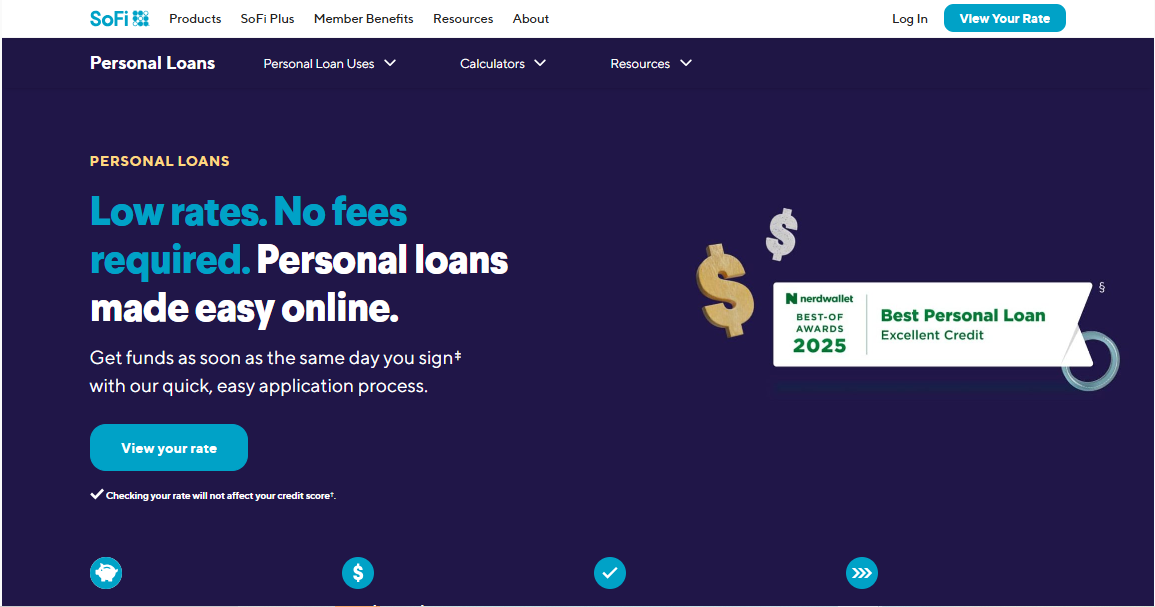
1. SoFi Personal Loans – Best Overall

Our Rating: ⭐⭐⭐⭐⭐

Why SoFi Tops Our List: SoFi offers flexible loan amounts, fast funding, and helpful customer support, with competitive APRs and no origination or application fees. SoFi’s rate ranges are from 8.99% to 29.49% APR, reflecting a 0.25% autopay discount and a 0.25% direct deposit discount.

Key Features:

  • APR Range: 8.99% – 29.49% with discounts
  • Loan Amounts: $5,000 – $100,000
  • Terms: 2 to 7 years
  • Min. Credit Score: None stated (typically 680+)
  • Origination Fee: None
  • Funding Speed: As soon as same day

Special Benefits:

  • 0.25% rate discount for debt consolidation when SoFi pays creditors directly
  • Free financial planning and career coaching for members
  • Unemployment protection program
  • No prepayment penalties

Best For: Borrowers with good to excellent credit seeking comprehensive financial support alongside competitive rates and large loan amounts.

Considerations: SoFi’s minimum credit score is 680, so consider other lenders if you have fair or bad credit. Minimum loan amount is $5,000.

2. LightStream by Truist – Best for Lowest Rates

Our Rating: ⭐⭐⭐⭐⭐

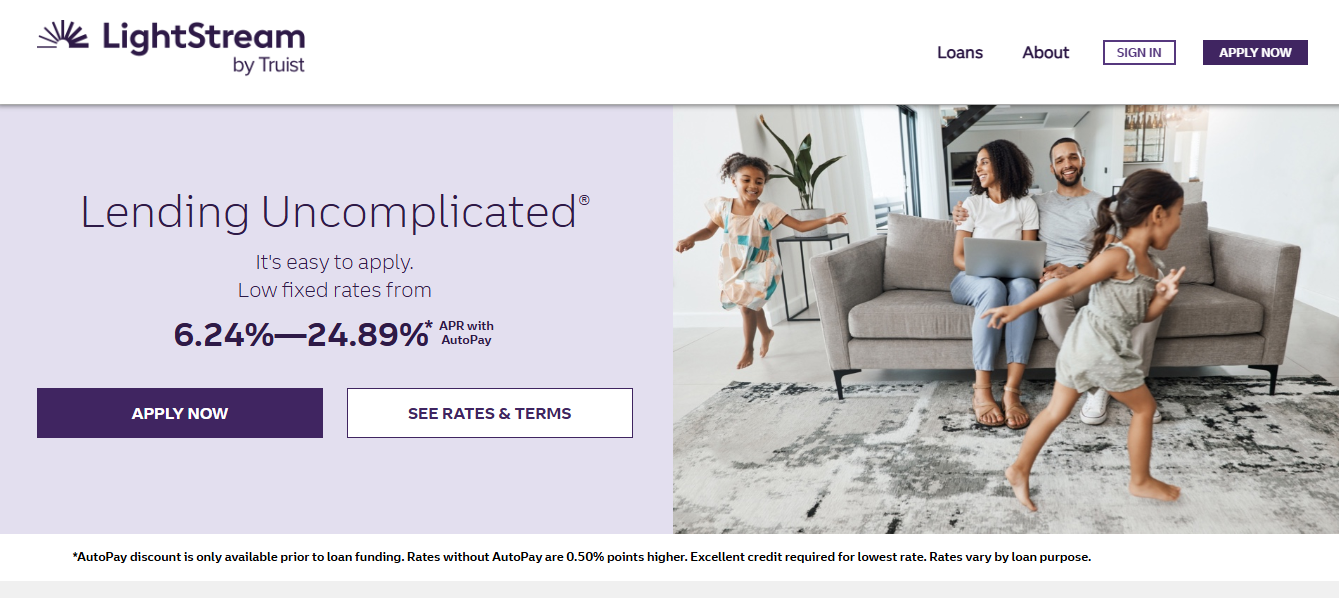
Why LightStream Excels: LightStream offers a lower potential APR at just 6.49% and publishes a policy stating it will beat eligible competitor unsecured loans by 0.10% if you’re approved for a lower rate.

Key Features:

  • APR Range: 6.49% – 24.89% with autopay
  • Loan Amounts: $5,000 – $100,000
  • Terms: 2 to 7 years (debt consolidation loans)
  • Min. Credit Score: 660 (excellent credit preferred for best rates)
  • Origination Fee: None
  • Funding Speed: Same day available

Special Benefits:

  • Rate Beat Program beats qualifying competitors by 0.10%
  • 0.50% autopay discount
  • Zero fees of any kind
  • Incredibly lengthy terms available (up to 240 months for some loan types)

Best For: Borrowers with excellent credit (720+) and strong income seeking the absolute lowest possible rates with no fees.

Considerations: Strict underwriting. You need excellent credit and financial stability to qualify for their best rates.

3. Discover Personal Loans – Best for No Fees

Our Rating: ⭐⭐⭐⭐½

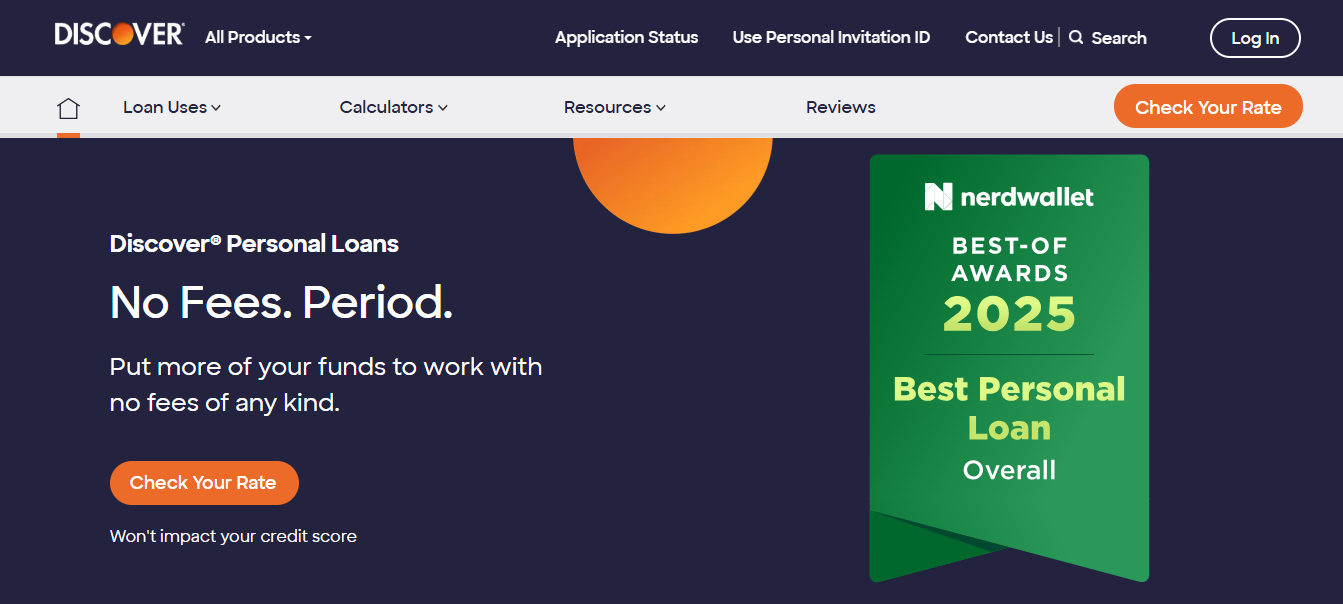
Why Discover Stands Out: Discover personal loans are good options for borrowers with good and excellent credit, offering competitive rates and no origination fees. The lender also offers no late fees and longer terms to keep payments low.

Key Features:

  • APR Range: Starting around 7% (varies by creditworthiness)
  • Loan Amounts: $2,500 – $40,000
  • Terms: 3 to 7 years
  • Min. Credit Score: Typically 660+
  • Origination Fee: None
  • Funding Speed: Next business day

Special Benefits:

  • No fees whatsoever. No origination, late, or prepayment penalties.
  • Direct payment to creditors option
  • Long weekend phone support hours
  • 30-day money-back guarantee on loans

Best For: Borrowers with good to excellent credit who want a reputable brand without any fees eating into loan proceeds.

Considerations: Maximum loan amount caps at $40,000, which may not be enough for very large consolidations.

4. Upgrade – Best for Fair Credit with Flexible Terms

Our Rating: ⭐⭐⭐⭐

Why Upgrade Works for Fair Credit: Upgrade accepts lower credit scores than similar lenders and offers multiple rate discounts for its personal loans.

Key Features:

  • APR Range: 7.99% – 35.99%
  • Loan Amounts: $1,000 – $50,000
  • Terms: 2 to 7 years (24 to 84 months)
  • Min. Credit Score: Typically around 580-600
  • Origination Fee: 1.85% – 9.99%
  • Funding Speed: Next business day

Special Benefits:

  • Multiple rate discount opportunities
  • Direct creditor payment option
  • No prepayment penalties
  • Free credit monitoring included
  • More accessible credit requirements

Best For: Borrowers with fair credit who want flexible term options and the ability to pay off early without penalty.

Considerations: Origination fees range from 1.85%-9.99%, which are deducted from loan proceeds. Factor this into your total cost calculation.

5. LendingClub – Best for Debt Consolidation Features

Our Rating: ⭐⭐⭐⭐

Why LendingClub for Consolidation: LendingClub may be a good pick for debt consolidation since the lender saves you hassle by making payments directly to your creditor, and may offer a consolidation rate discount.

Key Features:

  • APR Range: 7.04% – 35.99%
  • Loan Amounts: $1,000 – $40,000
  • Terms: 3 or 5 years
  • Min. Credit Score: 600
  • Origination Fee: 0% – 8%
  • Funding Speed: Possible within 24 hours of approval

Special Benefits:

  • Direct creditor payment for debt consolidation
  • Potential consolidation rate discount
  • Streamlined application process
  • Fast approval decisions
  • Flexible eligibility criteria

Best For: Borrowers who want hassle-free debt consolidation with direct creditor payment and fast funding.

Considerations: Origination fees up to 8% can add to costs. Terms are limited to 3 or 5 years with less flexibility than some competitors.

6. PenFed Credit Union – Best for Credit Union Members

Our Rating: ⭐⭐⭐⭐½

Why PenFed Excels: PenFed has an extremely customer-friendly maximum APR of just 17.99%, notably lower than most competitors. Credit unions may have friendlier maximum loan rates than banks.

Key Features:

  • APR Range: 8.99% – 17.99%
  • Loan Amounts: $600 – $50,000
  • Terms: Up to 60 months
  • Min. Credit Score: Not disclosed
  • Origination Fee: None
  • Funding Speed: Fast funding available

Special Benefits:

  • Exceptionally low maximum APR (17.99%)
  • No origination fees or prepayment penalties
  • Easy membership (virtually anyone can join)
  • Credit union member benefits
  • Competitive rates for all credit tiers

Best For: Borrowers seeking credit union benefits with lower maximum rates and no fees. Good option for those worried about high-rate caps.

Considerations: PenFed offers the smallest loan amounts out of our top picks, with a minimum of just $600. Must become a member (easy $5 savings account deposit).

7. Upstart – Best for Limited Credit History

Our Rating: ⭐⭐⭐⭐

Why Upstart’s Approach Works: Upstart’s innovative underwriting process makes its loans accessible to most borrowers, including those with insufficient credit history. Upstart has one of the most competitive starting APRs at 6.70%.

Key Features:

  • APR Range: 6.70% – 35.99%
  • Loan Amounts: $1,000 – $50,000
  • Terms: 3 or 5 years
  • Min. Credit Score: None (considers education, employment)
  • Origination Fee: Up to 12%
  • Funding Speed: As soon as the next business day

Special Benefits:

  • AI-powered underwriting considers education and employment history
  • No minimum credit score requirement
  • Low $1,000 minimum loan amount
  • Fast approval and funding
  • Good for thin credit files

Best For: Borrowers with limited credit history, recent graduates, or those whose education and career don’t reflect in traditional credit scores.

Considerations: Upstart charges an origination fee of up to 12% of the loan amount, deducted from the loan funds before you receive them. Not available for education expenses in some states.

8. Best Egg – Best for Secured and Unsecured Options

Our Rating: ⭐⭐⭐⭐

Why Best Egg Offers Flexibility: Best Egg offers the lowest starting rate (5.99% APR) for secured personal loans among top picks, giving borrowers options based on their situation.

Key Features:

  • APR Range: 5.99% – 35.99% (secured loans start lower)
  • Loan Amounts: $2,000 – $50,000
  • Terms: 3 to 5 years (36 to 60 months)
  • Min. Credit Score: Typically 600
  • Origination Fee: 0.99% – 9.99%
  • Funding Speed: 1-3 business days

Special Benefits:

  • Both secured and unsecured loan options
  • Lowest starting rate for secured loans
  • Fast funding (about half of customers get their money the next day)
  • Lower minimum than many competitors ($2,000)

Best For: Borrowers who want the option of a secured loan for better rates, or those with fair credit seeking quick funding.

Considerations: Origination fees apply. Terms limited to 36-60 months. Best Egg does not offer loans to co-borrowers.

9. Wells Fargo – Best for Existing Bank Customers

Our Rating: ⭐⭐⭐⭐

Why Wells Fargo for Current Customers: Wells Fargo is a strong pick for those hoping to avoid fees, as it doesn’t charge an origination fee, closing fee, or prepayment fee. Wells Fargo boasts a highly rated mobile app and more than 4,000 bank branches.

Key Features:

  • APR Range: Starting at 6.74%
  • Loan Amounts: $3,000 – $100,000
  • Terms: 1 to 7 years
  • Min. Credit Score: Good credit is typically required
  • Origination Fee: None
  • Funding Speed: Fast for existing customers

Special Benefits:

  • No origination, closing, or prepayment fees
  • Relationship discounts for existing customers
  • High loan amounts up to $100,000
  • 4,000+ branches for in-person support
  • Highly rated mobile app

Best For: Existing Wells Fargo customers consolidating large amounts of debt who want traditional bank reliability.

Considerations: Only those who have an open Wells Fargo account for at least 12 months are eligible. Approval standards are traditional, bank-strict.

10. Universal Credit – Best for Bad Credit

Our Rating: ⭐⭐⭐½

Why Universal Credit for Challenged Credit: Universal Credit may be a smart choice for borrowers with lower credit scores who want to consolidate debt.

Key Features:

  • APR Range: 11.69% – 35.99%
  • Loan Amounts: $1,000 – $50,000
  • Terms: 3, 4, or 5 years
  • Min. Credit Score: 560
  • Origination Fee: Varies
  • Funding Speed: Fast funding available

Special Benefits:

  • Accepts credit scores as low as 560
  • Considers factors beyond credit score
  • Direct creditor payment option available
  • Flexible qualification criteria

Best For: Borrowers with credit challenges who still want to consolidate and save compared to credit card rates.

Considerations: With lower credit scores, you’ll face higher APRs, but even 25% is better than 29% credit card rates. Limited term flexibility (only 3, 4, or 5 years).

Quick Comparison Table

LenderMin. APRMax APRLoan AmountsMin. Credit ScoreOrigination FeeBest For
SoFi8.99%29.49%$5K-$100K~680NoneOverall best, large loans
LightStream6.49%24.89%$5K-$100K660NoneLowest rates, excellent credit
Discover~7%Varies$2.5K-$40K660+NoneNo fees, good credit
Upgrade7.99%35.99%$1K-$50K~580-6001.85%-9.99%Fair credit, flexible
LendingClub7.04%35.99%$1K-$40K6000%-8%Debt consolidation
PenFed8.99%17.99%$600-$50KNot disclosedNoneCredit union benefits
Upstart6.70%35.99%$1K-$50KNoneUp to 12%Limited credit history
Best Egg5.99%35.99%$2K-$50K6000.99%-9.99%Secured/unsecured options
Wells Fargo6.74%Varies$3K-$100KGood creditNoneExisting customers
Universal Credit11.69%35.99%$1K-$50K560VariesBad credit

How to Choose the Right Lender for Your Situation

If You Have Excellent Credit (720+):

Focus on LightStream or SoFi for the lowest possible rates. Your strong credit profile qualifies you for rock-bottom APRs that will save thousands over the loan term.

If You Have Good Credit (670-719):

Consider Discover, SoFi, or PenFed. You’ll qualify for competitive rates with these lenders, and many offer no-fee options that maximize your savings.

If You Have Fair Credit (620-669):

Look at Upgrade, LendingClub, or Upstart. These lenders have more flexible requirements and may offer better rates than you expect, especially if you have strong income.

If You Have Bad Credit (Below 620):

Focus on Universal Credit, Upstart (no minimum score), or consider LendWyse’s income-focused network. Even with challenged credit, consolidation at 20-25% APR beats 29% credit card rates.

If You Have Strong Income But Challenged Credit:

Traditional lenders heavily weigh credit scores, which can disadvantage borrowers who experience temporary setbacks but now have stable income. LendWyse connects you with lenders who give proper weight to your current earning power alongside your credit history.

Beyond Rates: What Else Matters

Origination Fees Can Erase Rate Advantages

A 10% APR loan with a 5% origination fee might cost more than an 11% APR loan with no fees.

Always calculate total cost: (Monthly payment × Number of months) + Fees = True total cost

Direct Creditor Payment Simplifies Consolidation

Lenders like SoFi, LendingClub, and Discover can pay your credit cards directly, ensuring consolidation happens immediately and removing temptation to use those zero-balance cards.

Autopay Discounts Add Up

Most lenders offer 0.25%-0.50% rate reductions for autopay enrollment. Over a 5-year loan, this can save hundreds of dollars.

Term Length Balance

  • Shorter terms (2-3 years): Higher monthly payments, less total interest
  • Longer terms (5-7 years): Lower monthly payments, more total interest

Choose based on your budget capacity and urgency to be debt-free.

The Application Process: What to Expect

Step 1: Pre-Qualification (Soft Pull)

Most lenders offer pre-qualification with no credit score impact. Get pre-qualified with 3-5 lenders to compare actual rates you’ll receive.

Step 2: Compare Total Costs

Don’t just look at APR. Calculate the total repayment, including all fees, to identify the true best deal.

Step 3: Formal Application (Hard Pull)

Once you choose your lender, complete the full application. Have these documents ready:

  • Government-issued ID
  • Proof of income (pay stubs, tax returns)
  • Bank statements
  • List of debts to consolidate

Step 4: Review and Sign

Carefully review loan terms before signing. Verify APR, monthly payment, total interest, fees, and payoff date.

Step 5: Receive Funds

Funding timeframes vary by lender:

  • Same day: SoFi, LightStream (if approved early)
  • 1-3 business days: Most online lenders
  • 3-7 business days: Traditional banks

Common Mistakes to Avoid

Choosing a Lender Based Only on Monthly Payment: A 7-year loan at 15% has lower monthly payments than a 3-year loan at 10%, but you’ll pay thousands more in interest.

Ignoring Origination Fees: A 5% fee on a $20,000 loan costs you $1,000 upfront.

Not Shopping Around: Rates, terms, and amounts can vary significantly by lender, so it is worth the effort to compare offers from multiple personal loan companies.

Failing to Close Paid-Off Credit Cards Strategically: Keep your oldest card and 1-2 others for credit utilization purposes, but close cards you don’t need to avoid reaccumulating debt.

Applying to Too Many Lenders: Multiple hard inquiries in a short period can hurt your credit. Use pre-qualification tools first, then apply formally to your top 1-2 choices.

Special Consideration: Income-Based Lending

Traditional lenders heavily weigh credit scores, but an increasing number recognize that steady income matters just as much — if not more — than past credit challenges.

If you have a strong, stable income but your credit score doesn’t reflect your current financial situation, platforms like LendWyse connect you with lenders who:

  • Prioritize current income over past credit issues
  • Consider your debt-to-income ratio more heavily
  • Evaluate your ability to repay based on your earning power
  • Offer competitive rates for borrowers with solid income

This income-focused underwriting means you might qualify for better terms than traditional credit-score-heavy lenders would offer, even if you experienced financial difficulties in the past.

Find Your Perfect Match

The best personal loan lender in 2026 isn’t the one with the lowest advertised rate. It’s the one that offers you the best combination of approval likelihood, competitive rates, reasonable fees, and terms that fit your budget and goals.

With the best rates starting at 6.24% and average rates around 12.26%, there’s significant room for savings compared to credit card rates exceeding 20%. But the specific lender that’s “best” for you depends on your credit profile, income stability, and borrowing needs.

Don’t let another month of 20%+ credit card interest drain your budget. The right personal loan can save you thousands of dollars and put you on a clear path to debt freedom.

Ready to compare personalized offers from multiple lenders? Stop guessing what you might qualify for and start comparing real rates based on your complete financial profile — including your income, not just your credit score.

Get Your Personal Loan Quotes at LendWyse.com

Your path to lower interest rates and financial freedom starts with knowing what’s actually available to you. Take the first step today.

How to Pay Off Credit Card Debt Without a Loan

how to pay off credit card debt without a loan

Maybe you’ve been turned down for a consolidation loan. Maybe your credit score isn’t where it needs to be for a balance transfer. Or maybe you’re just tired of solving debt problems with more debt. Whatever your reason for searching how to pay off credit card debt without a loan, you’re looking for strategies that work with what you have right now.

Here’s the reality: you don’t need a loan to escape credit card debt. Learning how to pay off credit card debt without a loan means using direct tactics like negotiating with creditors, restructuring your payments strategically, and finding money in places you didn’t know existed.

It might take creativity and discipline, but it’s absolutely possible to become debt-free without borrowing another dollar. Let’s explore the proven methods that work.

Table Of Contents:

Why Another Loan Is Not Always the Answer

It is easy to see why a debt consolidation loan seems appealing. You get one single payment and maybe a lower interest rate. But it is often a temporary fix for a bigger problem.

A new loan does not change the spending habits that created the debt in the first place. Many people who get a personal loan to consolidate debt end up with more debt later. They use the loan, free up their multiple credit cards, and slowly start using them again, creating a dangerous cycle.

Unlike a car loan or a student loan, which are for a specific asset or education, a consolidation loan can provide a false sense of security. Before you know it, you could be facing the loan payment plus new credit card balances.

First, Look at Your Numbers

I know this is the part nobody likes, but you cannot get where you are going without a map. In this case, your map is a detailed budget. It is the only way to see exactly where your money is going and find extra cash to attack the debt you’re carrying.

Start by listing all your income sources for the month. Then, you need to track every single penny you spend by reviewing your checking account and credit card accounts. You can use a free app or a simple notebook; it just needs to be honest.

Once you have a full month of spending data, split it into two categories: needs and wants. Needs are things like rent, utilities, and basic groceries. Wants are optional stuff like streaming services, ordering takeout, spa treatments, vacations, and gym memberships.

This process gives you the power to change your financial future and pay off your debt faster.

Choosing Your Debt Payoff Method

Once you know how much extra money you can find each month, you need a payment schedule to use it effectively. Two popular methods have helped millions of people get out of debt.

The Debt Snowball Method

The debt snowball is all about momentum and psychological wins. It is less about math and more about seeing progress, which can be incredibly powerful for staying on track. This method is perfect if you feel discouraged by the large total amount you owe.

Here is how it works. You list all your card accounts from the smallest balance to the largest, ignoring interest rates. You make the minimum payment on every single debt except the smallest one.

You throw every extra dollar you have at that smallest debt until it is gone. When that first debt is paid off, you take the money you were sending to it and add it to the minimum payment for the next smallest debt.

As you pay off each card, the snowball of money you apply to the next one gets bigger and bigger.

The Debt Avalanche Method

If you are a numbers person, the debt avalanche method might be the better option. This method saves you the most money in interest over the long haul.

With the avalanche, you list your debts from the highest interest rate to the lowest, ignoring the balance. You make minimum payments on everything except for the debt with the highest interest rate. All your extra cash goes toward eliminating that one first.

This strategy might feel slower at the start, especially if your highest APR card also has a big balance. But, by tackling the most expensive debt first, you are stopping it from growing so quickly. Over time, you will pay much less in interest charges.

Feature Debt Snowball Debt Avalanche
Strategy Pay the smallest balance first Pay the highest interest rates first
Main Benefit Quick psychological wins Saves the most money over time
Best For Those needing motivation Those focused on efficiency
Potential Drawback May cost more in total interest Can feel slow at the beginning

How to Pay Off Credit Card Debt Without a Loan

A budget and a plan are great. But if you really want to get out of debt fast, you need to attack it from both sides. That means not just spending less but also earning more to create a bigger gap between what you make and what you spend.

Making Aggressive Cuts to Your Expenses

Look back at your budget and get serious about the wants column. This does not have to be forever, but for now, every dollar you do not spend is another dollar you can send to your creditors. You can start by looking for easy wins.

  • Review all your monthly subscriptions and cancel what you do not truly need.
  • Commit to making your coffee at home and packing your lunch for work.
  • Call your cable, internet, and cell phone providers to ask for a better rate or a promotional deal.
  • Plan your meals to reduce food waste and impulse trips to the grocery store.
  • Implement a 30-day waiting period for any non-essential purchase over $50.
  • Explore free entertainment options like the library, local parks, or community events.

These changes might feel small individually. But when you add them all up, you can easily find an extra few hundred dollars a month. That is a huge boost to your debt payoff plan.

Temporarily Increasing Your Income

Cutting expenses can only go so far. There is a limit to how much you can cut from your budget. There is, however, no limit to how much you can earn.

A temporary increase in your income can knock years off your debt freedom date. Have you considered asking for a raise at your current job? If you have been a good employee, prepare a list of your accomplishments and schedule a meeting with your boss.

Another option is to pick up a side hustle. In today’s gig economy, there are more options than ever. You could drive for a rideshare service, deliver food, do freelance work online, or sell items you no longer need.

Negotiate Directly with Your Card Company

One of the most underutilized strategies is simply talking to your credit card company. Many people assume the terms are set in stone, but that is not always the case. A phone call could save you a significant amount of money.

Before you call, review your account history and be prepared to explain your situation calmly and clearly. Let the customer service representative know you are committed to paying off your balance but are having trouble with the high interest rate. Ask if they have any programs or offers available to lower your APR.

Some creditors might offer a temporary hardship program if you are experiencing a short-term financial crisis. This could include a temporary reduction in your interest rate or minimum payment. Getting a more favorable payment plan can make all the difference.

Other Tools and Strategies That Are Not Loans

Sometimes, your budget and extra income are not enough to make a big dent, especially with high interest rates. Luckily, there are a few other powerful tools you can use. These are not loans but can help you lower your interest costs and manage your payments more effectively.

Using a Balance Transfer Card

A balance transfer card can be a game-changer if you use it correctly. These cards offer an introductory period, often 12 to 21 months, with a 0% APR on balances you transfer from other cards. This means your entire payment goes toward the principal, not interest, for the promotional period.

There are some things to watch for. Most cards charge a balance transfer fee, usually 3% to 5% of the amount you move. You also need a good credit score to get approved for the best offers, so it is a good idea to check your credit report first.

Most importantly, you must have a solid plan to pay off the balance before the 0% APR period ends. If you do not, the interest rate can jump to a very high number.

Remember: these balance transfers are a tool, not a magic solution.

Getting Professional Help

If you feel completely overwhelmed and have trouble paying, it might be time to get some help. Reputable, non-profit credit counseling organizations can be a great resource. A credit counselor can offer free or low-cost help to review your finances and create a realistic budget.

They might suggest a Debt Management Plan (DMP). A DMP is not a loan. Instead, the counseling organization works with your creditors to possibly lower your interest rates and combine all your unsecured debts into a single payment you make to the agency.

A debt management plan from a trusted credit counseling organization can provide much-needed structure and relief. Always check the credentials of any counseling organization you consider.

You might also hear about debt settlement. This is a very aggressive approach where a for-profit debt settlement company negotiates with your creditors to accept a lump sum payment that is less than what you owe. It is effective but you need to understand the pros and cons of this approach.

Should You Close Credit Card Accounts After Paying Them Off?

Once you start paying off your balances, you might be tempted to close each credit card account to avoid future temptation. While this seems logical, closing credit cards can sometimes hurt your credit score.

Two key factors in your score are your credit utilization ratio and the average age of your accounts.

Your credit utilization is the amount of credit you are using compared to your total available credit. Closing a card reduces your total available credit, which can increase your utilization ratio and lower your score.

Closing older accounts can also shorten your credit history, which can have a negative impact on your score.

Instead of closing the account, consider keeping it open with a zero balance. You can put a small, recurring charge on it and set up autopay to pay it in full each month. This keeps the account active and helps your credit score over the long term.

Conclusion

There is a way out of the credit card debt maze, and it does not have to involve taking on another loan. It starts with creating a budget so you know exactly what is happening with your money.

From there, you can choose a powerful strategy like the debt snowball or avalanche method to systematically eliminate each balance.

By finding ways to trim your spending and boost your income, you can accelerate your journey towards financial freedom. While the process requires discipline and sacrifice, the feeling of making that final payment and being truly free is worth every bit of the effort.

The sooner you take action on your debt, the more you’ll save. Start with Simple Debt Solutions and compare real offers today — so you can finally move forward with confidence.

How to Pay Off Large Credit Card Debt: Step-by-Step Guide

how to pay off large credit card debt

There’s a special kind of anxiety that comes with large credit card debt. That moment when you look at the balance and can’t imagine ever seeing it at zero. Whether it’s $15,000, $30,000, or more, the size of your debt can feel paralyzing.

How to pay off large credit card debt is about breaking an overwhelming mountain into manageable steps.

Large debt follows the same principles as small debt, just on a different timeline. Understanding how to pay off large credit card debt means having a clear roadmap that takes you from “this feels impossible” to “I’m actually making progress.”

You don’t need to have all the answers right now. You just need to know the next right step. Let’s walk through this together, one move at a time.

Table Of Contents:

Face the Numbers: Your First Step to Freedom

Okay, this is the part nobody likes. But you can’t fight an enemy you can’t see. You have to know exactly what you are up against to make any real progress on the debt you’re carrying.

Take a deep breath and gather every credit card statement. Open a simple spreadsheet or grab a notebook. You need to list out every single debt you have to see the full picture of your financial situation.

For each card, write down three things: the total card balance, the annual percentage rate (APR), and the minimum monthly payment. Having this information organized is a powerful first step to getting your card pay plan in order.

Create a Realistic Budget You Can Stick To

The word “budget” makes a lot of people cringe. They think it means no more fun, ever. But that’s not true at all. Creating a budget is the key to changing your money habits.

A budget is just a plan for your money. It puts you in the driver’s seat. It shows you where your money goes, instead of wondering where it all went at the end of the month.

A great place to start is the 50/30/20 rule. The idea is to spend 50% of your after-tax income on needs, 30% on wants, and 20% on savings and debt reduction. It is a simple framework to get you going as you set goals for your finances.

Track Your Spending

To make a good plan, you need good information. This means you need to track your monthly expenses for about a month. This sounds tedious, but it is often an eye-opening experience that reveals where your money truly goes.

You can use an app that connects to your bank account or just use a small notebook. Write everything down, from your morning coffee to your rent. The goal is to see the real patterns in your spending habits.

Find Areas to Cut Back

Once you see where your money goes, you’ll spot places to cut back. You are not looking to slash and burn your lifestyle to the ground. You are looking for small, sustainable changes that free up cash for debt payments.

Maybe it is brewing coffee at home a few times a week instead of buying it. It could be canceling a streaming service you hardly watch or planning meals to reduce food waste. These little cuts add up to big dollars you can throw at your debt.

Pick a Debt Payoff Strategy: Snowball vs. Avalanche

Now that you have found some extra cash in your budget, you need a smart way to use it. Two of the most popular debt repayment methods are the debt snowball and the debt avalanche.

Your personality and what motivates you will help you decide which one is the right fit. One focuses on psychological wins to keep your motivation high. The other method is based on pure math to save you the most money on interest.

Both methods require you to pay at least the minimum payment on all your credit card accounts. The difference lies in where you direct any extra money you have.

Feature Debt Snowball Debt Avalanche
Primary Focus Paying off the smallest balance first. Paying off the highest interest rate first.
Main Benefit Quick motivational wins to keep you going. Saves the most money on interest over time.
Best For People who need to see fast progress to stay motivated. People who want the most efficient, cost-effective plan.

The Debt Snowball Method

The snowball method is all about building momentum. You focus all your extra money on your smallest balance first. You continue making just the minimum pay on everything else.

Once that smallest debt is gone, you celebrate that win. Then, you take the money you were paying on that debt and roll it over to the next smallest one. This creates a “snowball” of cash that grows as you knock out each debt.

This method works because those quick victories can give you the emotional boost you need to keep going for the long haul. Seeing a card with a zero balance credit can be incredibly encouraging.

The Debt Avalanche Method

If you are a numbers person, the debt avalanche might be for you. With this method, you attack the debt with the highest rate first. You still make minimum payments on all your other cards.

High interest is what keeps you in debt longer because the credit cards charge so much. By tackling the highest APR first, you pay less in total interest over the life of your debt. This is the most financially efficient way to get out of debt.

The avalanche method will always save you the most money. But, it might take a while to pay off that first big debt. You have to be patient and trust that the math is working in your favor.

How to Pay Off Large Credit Card Debt Faster

Following a budget and a payment schedule is a huge leap forward. But what if you want to speed things up? There are several ways to put your debt pay plan into overdrive.

This involves either bringing more money in or lowering the debt you pay. Doing both at the same time can drastically cut down your debt-free timeline. It takes work, but the results can be life-changing as you start paying off balances.

Increase Your Income

The fastest way to pay off debt is to make more money. Easier said than done, right? But it might be more possible than you think.

You might be in a position to ask for a raise at your job. Research your market value and present a strong case to your boss. Even a small increase can make a huge difference in your monthly debt payments.

Think about skills you already have. Could you do some freelance work on the side? You could also explore the gig economy with things like food delivery, ride-sharing, or dog walking to earn extra cash in your spare time.

Use Balance Transfer Cards

High interest rates are like trying to swim against a current. A balance transfer card can be a lifesaver. These cards offer a 0% introductory APR for a certain period, usually 12 to 21 months.

You can move your high-interest debt from your old cards to this new one. Now, your entire payment goes toward the principal, not interest. Be aware that most cards charge a transfer fee, typically 3% to 5% of the amount you move, and some may have an annual fee.

The key is to pay credit card debt off entirely before the introductory period ends. If you don’t plan carefully, the interest rate will jump up, often to a very high number.

You’ll need a good enough credit score to qualify for the best balance transfers.

Consider a Debt Consolidation Loan

If you have a lot of different card balances, a debt consolidation loan could help. This is a personal loan you use to pay off all your credit cards at once. You are left with just one monthly payment to the new lender.

Often, personal loans have much lower interest rates than credit cards. This can save you a lot of money and simplify your finances. This works best if you have a decent credit score to qualify for a good rate.

You can look for these loans at your local bank, credit union, or online lenders that specialize in debt consolidation loans. Just be sure to read all the terms, including any potential closing costs, before signing anything.

Improve Your Credit Utilization Ratio

An often-overlooked tool in your arsenal is your credit utilization ratio. This ratio is the amount of credit you’re using divided by your total available credit. Lenders look at this number to gauge how reliant you are on borrowed money.

A high utilization ratio can hurt your credit score, making it harder to qualify for things like a balance transfer card or debt consolidation loan. Generally, you want to keep this ratio below 30%. Paying down your card balances directly improves this ratio.

As you lower your credit utilization, your credit score should improve. A better score could help you refinance your debt at a lower rate, saving you even more money in the long run.

Contact Your Credit Card Company

Before you explore more drastic options, try a simple phone call. Contact each credit card company and ask if they can lower your interest rate. Explain that you’re committed to paying off your balance but the high interest is making it difficult.

Some creditors have hardship programs or may offer a temporary rate reduction. The worst they can say is no. A successful call could save you a significant amount of money and accelerate your debt pay journey.

What if You Need More Help?

Sometimes, even with the best plan, the debt is just too much to handle on your own. If you can’t pay your bills and feel like you’re drowning, it is time to ask for help. There is no shame in seeking professional guidance.

Credit counseling and debt resolution programs exist for this exact situation. A reputable debt resolution company can work with you to create a personalized plan. They have relationships with creditors and can often negotiate on your behalf to lower payment amounts.

The Consumer Financial Protection Bureau, a key agency for financial protection, advises consumers to research any company thoroughly. The goal is to find a legitimate organization that has your best interests at heart.

Credit Counseling and DMPs

A non-profit credit counseling agency can be a fantastic resource. A certified credit counselor will review your entire financial picture with you. They can help you create a workable budget and provide valuable financial education.

They might suggest a debt management plan (DMP). Under a DMP, you make one monthly payment to the counseling agency, and they distribute it to your creditors. Often, credit counselors can negotiate lower interest rates or waived fees, helping you pay off your debt faster than you could on your own.

Debt Settlement

Debt settlement is a more aggressive option and should be considered carefully. This process involves negotiating with a card company to pay a lump sum that is less than the full amount you owe. While it can resolve debt for a fraction of the cost, it can also have a serious negative impact on your credit score.

This path is usually for people who are severely behind on payments and see no other way out. It’s crucial to work with a reputable debt settlement firm and understand all the fees and consequences.

Avoid any company that asks for large upfront fees or makes promises that sound too good to be true.

Conclusion

You didn’t get into debt overnight, and you will not get out of it overnight either. But now you have a roadmap. From understanding your numbers to choosing a payoff strategy and exploring ways to accelerate your progress, you have the tools you need.

Remember to avoid common pitfalls like taking a cash advance from one card to pay another, as the fees and interest rates are typically astronomical. Focus on your plan and the positive changes you are making.

Be kind to yourself during this process. There will be good days and bad days. The important thing is to keep moving forward, one step at a time, until you are finally free. With a clear plan and persistence, you now know how to pay off large credit card debt and reclaim your financial freedom.

Debt won’t fix itself — but the right plan can. Use Simple Debt Solutions to compare multiple loan offers in one place and find the option that helps you pay less and get out of debt faster.

Fixed vs Variable Loan Rates: Which Is Better for Your Situation?

fixed vs variable loan rates

When comparing personal loan offers, one of the most critical decisions you’ll face is choosing between fixed vs variable loan rates. This choice impacts more than just your monthly payment. It determines whether your rate stays locked in for the life of your loan or fluctuates with market conditions, potentially saving you money or costing you thousands more than expected.

Most personal loans come with fixed rates, offering the stability of predictable payments from day one until you’re debt-free. Variable rates, on the other hand, start lower but can increase (or decrease) over time based on market benchmark rates.

For borrowers consolidating significant credit card debt, understanding the fixed vs variable loan rates decision is essential. The wrong choice could undermine your entire debt payoff strategy.

The “better” option isn’t universal. It depends on your risk tolerance, how long you plan to carry the loan, your budget flexibility, and where interest rates are headed.

Let’s break down exactly how each rate type works, the advantages and risks of both, and how to determine which option protects your financial interests while maximizing your savings.

Table Of Contents:

What Is a Fixed Rate Loan?

A fixed interest rate means your rate is locked in for the entire life of the loan. Your monthly payment will be the exact same amount every single time, which simplifies your budget.

It doesn’t matter if market rates rise or fall; your payment is predictable. A fixed rate stays the same throughout your loan period, giving you stability.

This predictability is why most borrowers prefer a fixed-rate loan. Common examples include a fixed-rate mortgage, auto loans, and personal loans used for debt consolidation. Federal student loans also typically offer fixed rates, providing a consistent repayment schedule for graduates.

The Pros and Cons of a Fixed Rate

The biggest plus is definitely the stability. You have peace of mind knowing that a sudden change in economic conditions won’t wreck your budget. This is a huge relief when you’re already trying to get your finances on solid ground and improve your cash flow.

But, there can be a downside. Because the lender absorbs the risk of future rate increases, the initial rates on a fixed loan are typically higher than the starting rates for a variable option.

Also, if interest rates drop significantly, you’re stuck with your higher rate unless you refinance your current mortgage or loan, which can involve new fees and paperwork.

Ultimately, a fixed loan provides a clear picture of your total borrowing cost from day one. You know exactly how much you will pay monthly and how much interest you will pay over the entire term. This makes long-term financial planning much more straightforward.

So What About a Variable Rate Loan?

Your interest rate on a variable rate loan can change over time. These rates are usually tied to an underlying benchmark or financial index, like the U.S. prime rate, which is a base rate many banks use. If that benchmark rate goes up, your interest rate and your monthly payment will likely go up, too. The rate fluctuates based on the movements of its corresponding index.

This is exactly how most credit cards and business credit cards work. It’s a big reason why that balance you carry feels so hard to pay down. One month your interest charge is one amount, and a few months later, it can be higher, causing your loan payments to rise.

The Risk and Reward of Variable Rates

Why would anyone choose this uncertainty?

Often, a variable rate loan starts with a very low introductory or “teaser” rate. These initial rates can make them look very attractive at first and may help you save money in the short term.

If you get one and market conditions lead to decreasing rates, your payment could go down. That’s the potential reward, as you benefit when rates drop. The risk, of course, is that when rates go up, your payment could increase significantly, maybe to a level where you face higher payments you can no longer afford.

Most of these loans do have caps that limit how high the rate can go. But you need to understand the terms of the rate cap completely before you sign anything. This is especially true for an adjustable-rate mortgage (ARM). 

Feature Fixed Rate Loan Variable Rate Loan
Interest Rate Stays the same for the loan term. Changes based on a market index.
Monthly Payment Predictable and consistent. Can go up or down.
Risk Level Low risk for the borrower. High risk for the borrower.
Best For People who need a stable budget. People who can handle payment changes.

When Does a Fixed Rate Loan Make Sense?

For people trying to climb out of credit card debt, a fixed loan is the clearer path. You are trying to get away from the unpredictable interest of credit cards. Why would you trade that for another loan with the same problem of a rate variable based on market fluctuations?

With a fixed rate personal loan, you can combine all those high-interest debts into one single monthly payment. You’ll have a clear finish line and a defined repayment schedule. You’ll know the exact date your loan will be paid off, which can be a powerful motivator.

This structure gives you power and improves your cash flow. It helps you build a budget that you can actually stick to. You aren’t worried that a decision made by the Federal Reserve will suddenly make your payment unaffordable or that payments will increase unexpectedly. 

The mental benefit is just as big as the financial one. Escaping the stress of fluctuating credit card interest is a massive weight off your shoulders. A rate that stays the same gives you a sense of control over your financial future.

You can see the light at the end of the tunnel. Every single payment you make reduces your balance. You are actively paying down debt instead of just paying off the ever-growing interest charges.

Is a Variable Rate Loan Ever a Good Idea?

It might sound like a bad deal, but there are a few situations where variable rate loans might work. These are pretty specific circumstances, though. They usually involve less risk or a shorter time frame.

Let’s say you need a short term loan and you have a solid plan to pay it back very quickly. You might take a chance on a rate variable to get that lower starting interest rate. The goal would be to pay off the entire balance before the rate has a chance to rise much.

Another scenario is if interest rates are currently very high and many economists expect them to fall soon. By getting a variable rate, you’re betting that your payments will go down in the future. But this is a big gamble, and it’s tough to predict how economic conditions will change.

The Case for an Adjustable-Rate Mortgage

One of the most common variable rate loans is an adjustable-rate mortgage, also known as an ARM loan. These mortgage payments are not fixed for the entire loan term. An ARM typically offers a lower mortgage rate for an initial period, such as five or seven years, after which the rate adjusts periodically.

This mortgage type could be a good choice if you plan to sell the home before the initial fixed-rate period ends. For example, if you have a 7/1 ARM and know you will move in six years, you benefit from the lower rate without ever facing an adjustment. However, if your plans change and you stay longer, you face the risk of higher rates and larger monthly mortgage payments when rates change.

A variable-rate mortgage can be a strategic tool, but it requires careful consideration of your financial goals and risk tolerance. For some, the initial savings are worth the potential for future rate increases. For others, the certainty of a fixed-rate mortgage is non-negotiable.

Understanding the Caps

If you ever consider a variable rate loan, you must understand the rate caps. There’s usually a periodic cap, which limits how much the rate can increase in one adjustment period. There is also a lifetime cap, which is the absolute highest your rate could ever go during the life of the loan.

For example, an ARM loan might have a 2/2/5 cap structure. This means the rate cannot increase by more than 2% at the first adjustment, no more than 2% at subsequent adjustments, and no more than 5% over the lifetime of the loan from its initial rate. Understanding these limits is crucial for assessing the worst-case scenario.

You need to ask yourself if you could still afford the payment if it reached that lifetime cap. If the answer is no, then a variable-rate mortgage or other variable rate loans are probably too risky for you. It’s just not worth the stress if a rate increase would strain your finances. 

How The Economy Plays a Role in All This

Loan rates aren’t random; they reflect current market conditions. They are heavily influenced by the health of the U.S. economy. The main driver is the Federal Reserve, which sets a key benchmark rate to manage economic growth.

When the economy is growing fast and there are worries about inflation, the Federal Reserve usually raises interest rates to cool things down. This directly impacts the benchmark rates that variable loans are tied to. So, your variable rate loan payments will likely go up as the base rate increases.

On the other hand, during a recession or periods of slow growth, the Fed often lowers rates to encourage people to spend money and boost the economy. In that case, variable rates could fall, leading to a rate drop and lower payments for borrowers. Trying to time these economic cycles is hard, even for financial experts.

Conclusion

Choosing the right loan feels like a big test, but it doesn’t have to be. For most people working to get out from under a mountain of debt, stability is what they need most. A fixed rate loan gives you that solid ground to stand on while you rebuild.

A variable rate loan can sometimes offer a tempting low introductory rate, but it comes with real risks that your payments could rise later if rates increase. The decision on fixed vs variable loan rates comes down to what you are comfortable with.

Think carefully about your budget, your financial goals, and how much uncertainty you can handle before making a choice.

Get the loan you need without the guesswork. With LendWyse, you’ll see multiple offers at once, making it easier to choose and easier to save.

What Is Credit Utilization Ratio and Why It Matters

You pay your bills on time. You’ve never missed a payment. Yet your credit score is stuck or dropping, and you can’t figure out why. The culprit might be a metric you’ve never heard of: your credit utilization ratio. This could be the key to unlocking a better credit score without changing your payment habits at all.

Here’s the frustrating part: the credit utilization ratio isn’t exactly intuitive, and credit card companies don’t go out of their way to explain it. It’s the percentage of your available credit you’re currently using, and it accounts for roughly 30% of your credit score, second only to payment history in importance.

You could be damaging your credit score simply by using too much of your available credit, even if you pay it off every month. But once you understand how this ratio works, you can manipulate it in your favor and watch your score climb.

Let’s break down exactly what credit utilization is, why it matters so much, and how to optimize it.

Table Of Contents:

What Exactly Is Your Credit Utilization Ratio?

Your credit utilization ratio shows how much of your available credit you are currently using.

You do not need a fancy loan calculator or a degree in finance to calculate this. The math is simple, and you can do it right now with your latest credit card statements. It will give you a clear picture of where you stand.

The formula to find your overall ratio is straightforward. You just need to do a little division and multiplication. Here it is:

Total Balances ÷ Total Credit Limits x 100 = Your Credit Utilization Ratio.

This single number gives lenders a quick snapshot of your debt load. It is a critical piece of information they use to judge your creditworthiness when you check eligibility for new credit.

Let’s look at an example. Suppose you have two cards:

  • Card A has a balance of $8,000 and a credit limit of $10,000.
  • Card B has a balance of $12,500 and a credit limit of $15,000.

First, you add your balances together ($8,000 + $12,500 = $20,500). Then, you add your credit limits together ($10,000 + $15,000 = $25,000). Now, you just plug those numbers into the formula.

$20,500 ÷ $25,000 = 0.82.

Multiply that by 100 to get your percentage, which is 82%. Credit scoring models look at both your per-card utilization and your overall ratio. But the overall figure carries a lot of weight on your Equifax credit file and other reports.

Why Your Credit Utilization Ratio Is a Big Deal for Your Score

Your credit utilization score is one of the biggest factors that can pull your score up or down.

Both FICO and VantageScore, the two main credit scoring models, pay close attention to it.

According to myFICO, the “amounts owed” category, which includes your credit utilization, makes up a massive 30% of your entire FICO Score. Only your payment history matters more.

Think about it from a lender’s point of view. Someone with a high credit utilization ratio looks like a riskier borrower. It might signal to them that the person is financially stretched thin and is having trouble managing their money.

This perception of risk is what can really hurt you. A low credit score caused by high utilization rates means you will face higher loan rates if you need a car loan or want to check mortgage rates. You might even be denied new credit altogether when you really need it, or face higher insurance quotes for car insurance or life insurance.

What’s a “Good” Credit Utilization Ratio?

People often say to keep your credit utilization below 30%. That is not bad advice, but it is not the full story.

While staying under 30% is a good starting point, the truth is that lower is almost always better. An Experian analysis on credit utilization shows that consumers with the highest credit scores often have an average credit utilization ratio below 10%. Some even keep it under 7% to maintain good credit.

But please do not let that discourage you. If you are dealing with over $20,000 in debt, your ratio is almost certainly well above 30%. Your goal is not to hit 7% overnight; your goal is to make steady progress in the right direction to achieve a good credit utilization ratio.

Here is a simple way to look at different utilization levels:

Utilization Rate How Lenders See It
0% to 9% Excellent
10% to 29% Good
30% to 49% Fair
50% to 74% Poor
75%+ Very Poor

Finding your place on this chart can be a real wake-up call. But remember, this is not a permanent grade. It is a number that you can change, and even small improvements can help your credit score.

Smart Ways to Lower Your Credit Utilization Ratio

Now for the good part. How can you actually fix a high credit utilization ratio? You have several options, and you can use them together to get the best results.

Pay Down Your Balances

This is the most obvious and effective method. Every dollar you pay off on your credit card balances reduces your utilization ratio. I know this sounds hard when you have a lot of debt, but every little bit helps.

You might want to try a specific debt-payoff strategy. The “debt snowball” method involves paying off your smallest debts first for quick psychological wins. The “debt avalanche” method focuses on paying off debts with the highest interest rates first to save money over time.

Both methods work by having you make minimum payments on all debts except one. You throw all your extra money at that one target debt until it is gone. Then you roll that payment amount over to the next debt on your list, creating momentum.

Ask for a Credit Limit Increase

Here is a strategy that does not involve paying down debt. If you get a credit limit increase on a revolving credit account, it immediately lowers your utilization rate.

For example, if you have a $4,000 balance on a card with a $5,000 limit, your utilization is 80%.

If your credit card company increases your limit to $8,000, your balance is still $4,000. But now your utilization on that card drops to 50%. It is a quick fix that can have a big impact on your credit report.

But you need to be very careful with this. A higher credit limit is not an invitation to spend more. Using that new available credit will just put you right back where you started, or worse, and could lead to bad credit.

Make More Than One Payment a Month

This is a clever trick that many people do not know about. Most credit card issuers report your balance to the credit bureaus just once a month. This usually happens on your statement closing date.

It does not matter if you paid the balance in full a week after you got the bill. The balance that gets reported is whatever it was on that one specific day. So, if you made a big purchase and your balance is high on that date, your utilization will also be high.

You can beat this by making a payment right before your statement closing date. By lowering your balance just before it is reported, you can make your credit utilization ratio look better for that month. A good credit monitoring service can help you track these dates.

Avoid Closing Old Credit Cards

When you are trying to get out of debt, it can feel very tempting to close a credit card account as soon as you pay it off. It can feel like a victory. But this can actually backfire and hurt your credit score.

Closing a credit account does two negative things. First, it removes that card’s credit limit from your total available credit. This can cause your overall credit utilization ratio to suddenly spike, even if your debt level stays the same.

Second, it can shorten the average age of your credit history. The Consumer Financial Protection Bureau confirms that the length of your credit history is a factor in your score. A longer history is generally better, so it is wise to keep old, well-managed accounts open, even if you do not use them often.

How a Balance Transfer Can Help (and Hurt)

You have likely seen offers for a balance transfer credit card. These can be a useful tool for debt consolidation. The idea is to move high-interest debt from one credit card to a new one with a 0% introductory APR.

This move can dramatically impact your utilization rates. For example, moving a $5,000 balance from a maxed-out card to a new card with a $10,000 limit instantly improves your ratio. The old card now has 0% utilization, and the new card is at 50%.

However, you must be strategic. Opening a new credit account can temporarily dip your score due to a hard inquiry. Also, make sure you can pay off the transferred balance before the introductory period ends, or you could face high interest rates on the remaining amount.

Credit Utilization for Small Business Owners

If you are a small business owner, managing credit can get complicated. Many owners use personal credit to fund their operations, which can skyrocket their personal credit utilization. This makes it difficult to qualify for other financing, like auto loans or a mortgage.

A better approach is to establish business credit that is separate from your personal finances. Start with a business bank and open a business checking account. From there, you can apply for business credit cards.

Most business credit cards do not report activity to your personal credit reports unless you default. This allows you to explore business financing options without damaging your personal credit scores. A strong business credit profile is essential when applying for a business loan to grow your company.

Beyond Credit: Your Complete Financial Picture

While your utilization ratio focuses on revolving credit, lenders look at your entire financial profile. Having healthy bank accounts, like a savings account or money market account, demonstrates stability. These accounts show you have cash reserves and are not solely reliant on credit.

Strong relationships with financial institutions can be beneficial. Some banks offer better loan rates or credit products to existing customers with a good history. It is all part of building a solid foundation that supports your financial goals, from wealth management to simply getting a fair insurance quote.

Conclusion

Your credit utilization ratio is not just another piece of financial jargon. It is a vital sign of your financial health, and it is a number that you can actively manage and improve. Lenders are watching it, and now you know how to watch it, too.

Facing a large amount of debt can feel overwhelming, but information gives you power. By understanding your credit utilization and taking small, consistent steps to lower it, you are not just improving a number. You are laying a stronger foundation for your entire financial future and on the path to good credit.

Debt won’t fix itself — but the right plan can. Use Simple Debt Solutions to compare multiple loan offers in one place and find the option that helps you pay less and get out of debt faster.

How to Pay Off Credit Card Debt When You Live Paycheck to Paycheck

how to pay off credit card debt when you live paycheck to paycheck

Living paycheck to paycheck while carrying credit card debt feels like being trapped in a cycle with no exit. Every dollar is already spoken for before it hits your account, and the idea of “finding extra money” to pay down debt seems impossible. But figuring out how to pay off credit card debt when you live paycheck to paycheck isn’t about having money you don’t have; it’s about working smarter with what you do have.

The truth is, thousands of people have managed to escape credit card debt while living on tight budgets. Learning how to pay off credit card debt when you live paycheck to paycheck means using strategies that don’t require suddenly earning more or cutting expenses that are already bare-bones.

You don’t need a financial miracle. You need a realistic plan that works with your actual life. Let’s build one together.

Table Of Contents:

First, Look at the Numbers

I know this is the part many people avoid. It can be the scariest step, but you cannot get where you’re going if you do not know where you are. Take a deep breath and gather all your credit card statements and any other debt information, like a student loan statement.

Open a simple spreadsheet or just use a piece of paper and write down four things for every single card and loan: the name of the creditor, the total balance you owe, the minimum monthly payment, and the interest rate or APR. Seeing the total debt number in black and white might feel like a punch to the gut, but try to see it as just data.

This is your starting point, not your final destination. Knowing these figures is the first real act of taking back control of your financial wellness and changing your money habits for the better. This is how you identify areas where interest is costing you the most.

Make a ‘For Now’ Budget

The word budget makes a lot of people cringe, so let’s call it a temporary spending plan for getting out of debt. You need to track exactly where your money is going, not where you think it’s going.

Pull up your last 30 to 60 days of transactions from your bank account and debit card to see the truth. Group your spending into categories to understand your monthly expenses.

Start with your four walls: housing, utilities, food, and transportation. Then list everything else, from software subscriptions and streaming services to dining out and other non-essential expenses.

This exercise is essential for breaking free from the paycheck-to-paycheck cycle. Creating a realistic monthly budget gives you power by showing you exactly where your monthly income goes. It is the only way to find extra cash to put toward your debt.

Build a Small Emergency Fund

This may sound counterintuitive when you are eager to pay off debt. However, building a small emergency fund before you aggressively attack your balances is a critical step. A small, unexpected expense can easily derail your progress if you have no cash reserves.

Without a safety net, a car repair or medical bill could force you to use a high-interest credit card, adding to your debt. Your initial goal is not a fully funded emergency fund of three to six months of expenses. Instead, focus on saving a starter fund of $500 or $1,000 as quickly as possible.

Open a separate savings account for this money, preferably a high-yield savings account that earns a little extra interest. Keep this money separate from your regular checking account to reduce the temptation to spend it. This fund is your buffer against life’s little financial surprises.

Choose Your Battle Plan: Avalanche vs. Snowball

Now that you know your debts and have a spending plan, you can choose how to attack the debt.

There are two popular and effective debt repayment methods: avalanche and snowball. Neither is right or wrong. It’s about what works for you and keeps you motivated on your journey to become debt-free.

The Debt Snowball Method

This method is all about small wins to build momentum and improve your mental health. You list your debts from the smallest debt balance to the largest, completely ignoring the interest rates. You will make the minimum payment on all your debts except for the very smallest one.

For that smallest debt, you throw every single extra dollar you can find at it until it is gone. Once you pay it off, you take the payment you were making on it and roll it over to the next smallest debt. This creates a “snowball” of money that gets bigger as you pay off each debt.

The psychological boost you get from crossing a debt off your list is a powerful motivator. The debt snowball method is fantastic for people who need to see progress quickly to stay in the fight. The feeling of success can fuel your desire to pay your debt faster.

The Debt Avalanche Method

If you are driven by numbers, this plan is for you. With the debt avalanche, you list your debts by their interest rate, from highest to lowest. Again, you will be making minimum payments on everything except for one.

All your extra cash goes toward the debt with the highest APR, usually a high-interest credit card. Because high-interest credit costs you the most money over time, this method will save you the most in interest payments. It is mathematically the most efficient way to pay off what you owe.

It might take longer to get your first win, but you will pay less in the long run and get out of debt faster. Choosing between the two comes down to personal finance philosophy: Do you need the emotional wins of the snowball, or the financial efficiency of the avalanche?

Method Best For Pro Con
Debt Snowball People who need quick wins to stay motivated. Builds momentum and feels rewarding early on. You will pay more in total interest charges.
Debt Avalanche People focused on saving the most money. Mathematically the fastest and cheapest way to pay off debt. May take longer to pay off the first debt.

Finding Extra Cash

This is the big question. If you live paycheck to paycheck, where does this “extra” money come from?

It has to be created from two places: cutting your spending or increasing your income. Doing both is the most effective way to see rapid results.

Cutting Your Expenses

Go back to that spending plan you created. Look at the “wants,” not the “needs,” to find opportunities. This part requires sacrifice, but remember it is temporary and for a greater long-term goal.

Finding ways to reduce spending can be empowering. Can you cancel a few streaming services? Can you pause the gym membership and work out at home for a while? Every dollar you trim from your expenses is another dollar you can throw at your debt.

Look at negotiating bills like your cell phone or car insurance for more savings.

Making coffee at home or packing your lunch every day may seem small. But over a month, these small changes can add up to $100 or more that you can use for your snowball or avalanche method.

Boosting Your Income

Cutting expenses has a limit because you can only cut so much. Boosting your monthly income, on the other hand, is limitless. You do not have to get a second full-time job; think about a flexible side hustle.

Can you drive for a food delivery service a few nights a week? Are you good at writing or graphic design? Platforms like Upwork connect freelancers with projects. Even simple things like dog walking, babysitting, or selling things you no longer need on Facebook Marketplace can bring in extra cash.

Some people even turn a side hustle into a small business, which can be an excellent way to increase income over the long term.

The rule is simple: every dollar of extra money you earn goes straight to your debt, not into your regular spending.

Look into Debt Management Tools

As you start making progress, a few tools might help speed things up. These are not magic solutions, and they do not work for everyone. But they are worth investigating to see if they fit your situation.

Balance Transfer Credit Cards

If you have a decent credit score, you might qualify for a balance transfer credit card. These cards often have a 0% introductory APR for a short period, like 12 or 18 months. You can move your high-interest debt from another card onto this new card.

This allows you to make payments that go entirely to the principal balance instead of being eaten up by interest. There is usually a fee, around 3% to 5% of the balance, and you have to be disciplined. You must pay off the balance before the 0% period ends, or the interest rate will jump up.

Debt Consolidation Loans

Another option is a debt consolidation loan. This is a personal loan that you use to pay off all your credit cards at once. This simplifies your life because you only have one monthly payment to worry about.

If you can get a loan with an interest rate lower than what you are paying on your credit cards, you will save money. The Federal Trade Commission offers good advice on this, warning consumers to shop around for the best terms.

You have to commit to not running up the credit card balances again after you pay them off with the loan. A debt consolidation loan just reorganizes your debt; it does not eliminate it.

Debt Management Programs

If you feel completely overwhelmed, a debt management program (DMP) from a non-profit credit counseling agency might be a good option. In this type of management program, a counselor works with your creditors to potentially lower your interest rates. You then make a single monthly payment to the agency, and they distribute it to your creditors.

A debt management program can be a structured way to handle your debt repayment over three to five years. It’s a form of debt management that provides support and a clear plan. Be sure to work with a reputable, accredited agency.

Conclusion

Feeling trapped by the paycheck-to-paycheck cycle and card debt is tough, but it does not have to be permanent. Breaking free from debt starts with the decision to face the problem head-on and make a clear plan. It takes discipline and some temporary sacrifices, but the financial wellness on the other side is worth every bit of the effort.

Check your numbers, create a budget, build a small emergency fund, and choose a debt payoff strategy. Then, you can accelerate your progress by finding ways to cut spending and increase your income. Using tools like a balance transfer or debt consolidation loan can help, but they are not a substitute for changing your habits.

Following these steps gives you a real-world map for how to pay off credit card debt when you live paycheck to paycheck. Start making changes today that will lead to a debt-free life.

Debt won’t fix itself — but the right plan can. Use Simple Debt Solutions to compare multiple loan offers in one place and find the option that helps you pay less and get out of debt faster.

The Personal Loan Approval Process Explained Step-by-Step

Applying for a personal loan can feel like a black box. You submit your information and wait nervously to see if you’re approved, without really understanding what’s happening behind the scenes. The personal loan approval process doesn’t have to be mysterious. When you know exactly what lenders evaluate at each stage, you can position yourself for success and avoid the common mistakes that lead to rejections or unfavorable terms.

The approval process typically unfolds in five distinct stages: pre-qualification, formal application, underwriting review, final approval, and funding. Each stage serves a specific purpose, and understanding what lenders look for at each checkpoint helps you provide the right information at the right time.

Whether you’re consolidating credit card debt or covering a major expense, knowing the personal loan approval process from start to finish puts you in control instead of leaving you guessing.

Table Of Contents:

What to Do Before You Apply for a Personal Loan

Jumping straight into a loan application can actually hurt your chances. A little bit of prep work goes a long way.

First, Check Your Credit Score

Your credit score is a big piece of the puzzle. It is a number that gives lenders a quick look at your credit history and reliability with borrowing money. A higher score often means you can get a lower interest rate, saving you a lot of money over time.

Lenders use scores like the FICO® Score to make decisions about your approval odds. While you do not need a perfect score, a high score generally gets you better offers from multiple lenders.

You can check your score for free from many credit card companies or get your full credit reports from AnnualCreditReport.com. Knowing where you stand helps you find lenders that work with people in your credit range. This one step can save you a lot of time and frustration and is a good first move to build credit.

Calculate Your Debt-to-Income (DTI) Ratio

Another number that lenders look at closely is your debt-to-income ratio, or DTI. It sounds technical, but it is pretty simple. It is all of your monthly debt payments added up and then divided by your gross monthly income, which is your income before taxes.

Lenders use this to see if you can comfortably handle another monthly payment. Most lenders prefer a DTI below 43%. If yours is high, it could be a red flag for them.

Figuring out your DTI before you apply gives you a realistic view of your financial picture. It shows you what a lender sees when they look at your finances. If it is high, you might consider paying down some small debts before applying for personal loans.

What Lenders Look For

Before diving into the steps, it helps to understand the main criteria lenders evaluate. They generally focus on your ability to repay the loan. This often comes down to your creditworthiness, income, and the stability of your financial life.

Your payment history is a major factor, as it shows how you have handled past debts. Lenders will review your credit reports to see if you have a record of on-time payments. A history of late payments can signal higher risk.

Your income and employment status are also critical. Lenders want to see a stable source of income sufficient to cover your existing debts plus the new estimated monthly payment. A steady job history can greatly improve your chances of approval.

The Step-by-Step Personal Loan Approval Process

Okay, once your prep work is done, you are ready to start the actual process. Knowing what to expect at each stage makes everything feel much more manageable.

Step 1: Prequalification – The No-Risk First Look

Prequalification is like window shopping for a loan. You give a lender some basic financial information, and they tell you what kind of loan amounts, loan rates, and loan terms you might get. This is not a formal application or a guarantee of a loan.

The best part is that it almost always uses a soft credit check. A soft credit check, or soft pull, does not impact your credit score at all. This means you can get prequalified with several different lenders to compare offers without any penalty.

Step 2: Gather Your Important Documents

When you decide to move forward with a lender, you will need to prove that the information you gave them is accurate. This is where your paperwork comes in. Having everything ready to go will make the whole process much faster.

You will typically need to have these items ready:

  • Proof of identity, like a driver’s license or passport.
  • Proof of income, such as recent pay stubs, W-2s, or tax returns if you’re self-employed.
  • Bank statements from the last few months to show cash flow.
  • Your Social Security number for identity verification and credit checks.
  • Proof of your address, like a utility bill or lease agreement.

Each lender might ask for slightly different things. But this list covers what most of them will want to see. Organizing these documents in a folder on your computer can make submitting super easy.

Step 3: Submitting the Formal Application

After you have picked your best offer and have your documents ready, it is time to fill out the full application. This step is more detailed than the prequalification form, and you will have to confirm all your personal and financial details.

This is the point where the lender will perform a hard credit inquiry. A hard inquiry shows up on your credit report and can cause your score to dip by a few points temporarily. This happens because you are actively applying for new credit.

That is why you only want to submit a formal application with the one lender you have decided to go with. Too many hard inquiries in a short time can look like you are desperate for cash, which can lower your approval odds.

Step 4: Underwriting and Verification

Once you hit submit, your application goes into underwriting. This is where a person or a computer system carefully reviews everything. They are checking to make sure you are who you say you are and that you can afford the loan.

The underwriter will look at your credit report, income documents, and DTI. They are basically double-checking all the facts. They might even call your employer to verify that you work there, a standard part of the process.

This is the most critical waiting period. The underwriter is the one who makes the final call on your loan. If they have any questions, they will reach out to you, so it is a good idea to be responsive.

Step 5: The Decision – Approved, Denied, or a Counteroffer

After the underwriting is complete, you will get a decision. There are usually three possible outcomes. You could be approved, denied, or you might get a counteroffer.

If you are approved, that is great news. You will get a formal loan agreement to review. Do not just skim it; read it carefully, paying attention to lender charges like origination fees or any prepayment penalties.

If you are denied, it can be disappointing, but do not panic. The lender is required to send you a letter explaining why. This feedback is valuable because it tells you what you need to work on, like improving your credit score or lowering your DTI.

Sometimes, a lender will come back with a counteroffer. They might offer you a smaller loan amount or a higher interest rate than you asked for. You will have to use a personal loan calculator to see if the new estimated monthly payments still work for your budget.

Step 6: Signing the Agreement and Getting Your Money

If you are approved and you like the terms, the final step is to sign the loan agreement. You can usually do this electronically. This document is a legal contract, so make sure you understand the Annual Percentage Rate (APR), any fees, and your monthly payment schedule.

After you sign, the lender will send the money. This is called funding. How fast you get the cash can vary, but many online lenders can get it to you in just one or two business days.

The funds are usually deposited directly into your bank account. If you’re using the loan for debt consolidation, some lenders offer to send the money directly to your creditors. This can simplify the process of paying off your credit card balances.

How Long Does the Personal Loan Approval Process Take?

One of the biggest questions people have is about the timeline. The truth is, it depends a lot on the lender you choose. Online lenders have really streamlined the system, making them a very fast option to borrow personal funds.

Here is a general idea of what you can expect from different types of loan lenders:

Lender Type Typical Approval and Funding Timeline
Online Lenders 1 to 7 business days
Traditional Banks 3 to 7 business days
Credit Unions 1 to 10 business days

Your own situation can also affect the speed. If your application is straightforward and you send in your documents right away, it will move much faster. Delays usually happen when information is missing or the lender has trouble verifying something from your file.

Tips for a Smoother Loan Approval

You can do a few things to make your experience much smoother. It is all about being prepared and proactive.

First, check your credit report for any errors before you apply. A mistake could unfairly drag your score down. Disputing errors with the credit bureaus can be a simple way to give your score a boost.

Also, have all your documents scanned and ready to upload. Fumbling to find a pay stub can slow everything down. Being organized shows the lender you are on top of your finances and serious about the loan application.

And finally, always be honest on your application. Lenders have ways of verifying everything. Lying about your income or other details will only get your application denied and could get you in more trouble.

Conclusion

The personal loan approval process doesn’t have to feel intimidating. From pre-qualification through final funding, each step brings you closer to consolidating that high-interest debt and regaining financial control — as long as you’re prepared with the right documentation and realistic expectations.

Remember, approval isn’t just about meeting minimum requirements. It’s about presenting yourself as a reliable borrower through accurate information, complete documentation, and demonstrating both the ability and commitment to repay.

Don’t let another month of high-interest credit card payments drain your budget. With the right preparation and a lender who values your complete financial picture (including your steady income, not just your credit score), you could be approved and funded within days.

Begin Your Personal Loan Application at LendWyse.com

How to Pay Off $10,000 Credit Card Debt in 2026

how to pay off $10000 credit card debt

Staring at $10,000 in credit card debt can feel overwhelming, especially as you’re thinking about what you want to accomplish this year. But here’s some good news: learning how to pay off $10,000 credit card debt isn’t about perfect credit or a massive windfall; it’s about having a clear plan and taking consistent action.

Whether you can realistically eliminate this debt in 12 months or you’re looking at a longer timeline, the strategies for how to pay off $10,000 credit card debt are the same: lower your interest rates, increase your payments where possible, and stay focused on progress over perfection.

This year can be the year you finally break free from that balance. Let’s map out exactly how to make it happen.

Table Of Contents:

Understand Your Debt Situation

Before you start paying off your debt, you need to know exactly where you stand. Gather all your credit card statements and make a list of your balances, interest rates, and minimum payments.

Add up the total amount you owe across all your cards. This gives you a clear picture of what you’re dealing with. Knowing the full scope of your debt is crucial for making a solid plan to pay it off.

Create a Budget

To pay off your credit card debt faster, you need to free up extra cash. Start by tracking your spending for a month. Write down every expense, no matter how small.

Once you have a clear picture of your spending habits, look for areas where you can cut back. Maybe you can cook at home more often or cancel subscriptions you are not frequently using. Every dollar you save can go towards paying down your card balance faster.

Choose a Debt Payoff Strategy

There are two popular methods for paying off credit card debt: the debt snowball method and the debt avalanche method. Both can be effective, but one might work better for your situation.

The Debt Snowball Method

With this approach, you focus on paying off your smallest debt first while making minimum payments on the others. Once the smallest debt is paid off, you move to the next smallest, and so on.

This method can be motivating because you see progress quickly. It’s great if you need some early wins to stay motivated. However, it might cost you more in interest over time.

The Debt Avalanche Method

This strategy involves paying off the debt with the highest interest rate first. You make minimum payments on all other debts and put any extra money towards the high-interest debt.

The avalanche method can save you more money in interest over time. But it might take longer to see progress, especially if your highest-interest debt is also your largest balance.

The Debt Snowflake Method

Here’s a rather unusual method for debt relief. The debt snowflake method involves making micro-payments towards your debt whenever you can.

Found $5 in your coat pocket? Put it towards your debt.

Got a small refund? Use it to pay down your balance.

These small amounts might not seem like much, but they can add up over time. Plus, it keeps you focused on your goal of becoming debt-free.

Consider a Balance Transfer

If you have a good credit score, you might qualify for a balance transfer credit card. These cards often offer a 0% introductory APR for a set period, usually 12-18 months.

Transferring your high-interest debt to a 0% card can save you a lot in interest charges. But be aware of balance transfer fees, which are typically 3-5% of the amount transferred.

Make sure you can pay off the balance before the introductory period ends. If not, you might end up paying high interest rates again.

Negotiate with Your Credit Card Companies

It never hurts to ask your credit card companies for a lower interest rate. If you’ve been a good customer and make your payments on time, they might be willing to work with you.

Even a small reduction in your interest rate can save you money over time. This leaves more of your payment going towards the principal balance instead of interest.

Increase Your Income

Finding ways to earn extra money can speed up your debt payoff journey. Consider taking on a part-time job or starting a side hustle.

You could also sell items you no longer need. Look around your home for things of value that you can part with. Every extra dollar you earn can go straight towards your debt.

Consider Debt Consolidation

Debt consolidation involves taking out a new loan to pay off multiple debts. This can simplify your payments and potentially lower your interest rate.

Personal loans often have lower interest rates than credit cards. If you qualify for a low-rate personal loan, you could use it to pay off your credit cards and then focus on repaying just one loan.

Be cautious with debt consolidation loans. Make sure the new loan truly offers better terms than your current debts.

Avoid New Debt

While you’re working to pay off your debt, it’s crucial to avoid taking on new debt. Cut up your credit cards if necessary, or freeze them in a block of ice.

Switch to using cash or a debit card for your everyday expenses. This can help you stick to your budget and avoid the temptation of easy credit.

Stay Motivated

Paying off $10,000 in credit card debt takes time and dedication. Find ways to stay motivated throughout the process. You could create a visual representation of your debt payoff journey and update it regularly.

Celebrate small milestones along the way. Maybe treat yourself to a movie night when you pay off your first $1,000. Just make sure your rewards don’t derail your progress.

Seek Professional Help if Needed

If you’re really struggling to make progress on your debt, consider seeking help from a credit counselor. They can provide personalized advice and might be able to negotiate with your creditors on your behalf.

Look for a non-profit credit counseling agency. Many offer free or low-cost consultations. They can help you create a debt management plan tailored to your situation.

Conclusion

Paying off $10,000 in credit card debt isn’t easy, but it’s definitely possible with the right strategy and mindset. Remember, you didn’t get into debt overnight, and you won’t get out of it overnight either. Be patient with yourself and stay committed to your goal.

By understanding your debt, creating a budget, choosing a payoff strategy, and exploring options like balance transfers or debt consolidation, you can make steady progress. Combine these strategies with efforts to increase your income and avoid new debt, and you’ll be on your way to financial freedom.

The sooner you take action on your debt, the more you’ll save. Start with Simple Debt Solutions and compare real offers today — so you can finally move forward with confidence.

?

Wait! Don't Miss Out

You're About to Leave Without Saving Money!

Join the 1,432 people who got loan offers today and started saving on their high-interest debt.

$8,500

Avg. Savings

2 min

Application

No Impact

Credit Check